
How MakerX helped Macquarie University blaze a trail for safe AI in Australian higher education


Macquarie University is one of Australia's leading research-intensive universities, with a community of staff, students, and researchers spread across campuses and faculties. As generative AI moved from novelty to everyday tool, the university recognised both the opportunity and the risk: people across the organisation were keen to put AI to work, but only if their data and the university's information stayed safe. The result of the partnership with MakerX was ChatMQ, a platform Macquarie describes as Australia's first purpose-built modular AI solution built on open-source libraries, now in the hands of all 3,500 staff and running in a sovereign, Australian-based environment.
The brief had two parts. The first was a conversational AI experience that any staff member could use with confidence, with multiple frontier models behind it and the assurance that their inputs were not being sent away without controls. The second was an AI gateway sitting behind the scenes, giving development teams across the university a governed way to build their own AI-powered tools and applications on the same foundations. Both pieces needed to be safe, secure, and scalable to a university the size of Macquarie, and they needed to feel professional and trustworthy from day one.
When Macquarie went looking for a delivery partner, MakerX stood out for the combination of customer focus and engineering rigour the project demanded. There was a clear early-stage vision and a working prototype, but turning that into something the university could rely on was a different kind of problem. It needed deep AI domain knowledge, real experience deploying enterprise solutions on Azure, and the discipline to put the right CI/CD, infrastructure, and platform foundations in place from the start.
"We needed a partner who could take our initial vision and turn it into a high-quality, enterprise-ready solution. MakerX brought that balance between engineering excellence and customer focus, which is rare, and they delivered on both fronts,” said ." — Richard Watts-Seale, Interim Head of AI, Macquarie University. “Critically, we felt MakerX mirrored our approach to AI as an enabler of human connection and creativity.
“The creation and sharing of knowledge is central to the core mission and societal purpose of universities, so getting AI right is vitally important. Macquarie’s commitment to responsible AI means we need a mission-centric and human-first approach. People still need to do the thinking, ask the right research questions, and exercise rigorous judgement and oversight over the system.”
The most demanding part of the work was productionising the early vision. The prototype showed what was possible but was a long way from something a university could put in front of thousands of people. MakerX worked alongside Macquarie's team to put sound engineering practice underneath the idea, hardening the chat experience, building out the AI gateway, and turning a rough concept into a platform that could carry real load and real expectations.
"The hardest part of any project like this is moving from prototype to platform without losing the spark of the original idea. We worked closely with Macquarie to keep the vision intact while putting the engineering foundations in place that a university the size of Macquarie genuinely needs. The AI gateway is the part that excites me most. It is the architectural choice that lets the rest of the university innovate safely on top." — Rob Moore, Chief Technology Officer, MakerX
A clear theme emerged through the conversations MakerX had with people across the university. Staff were aware of the privacy risks of using public AI tools and were holding back because of them. What they valued most was a safe space where they could bring internal and even confidential Macquarie documents into a conversation with an AI and know the data was being handled appropriately. The ability to upload university documents and work with them securely turned out to be one of the most important outcomes of the project, and it became the killer use case for power users doing intensive document analysis.
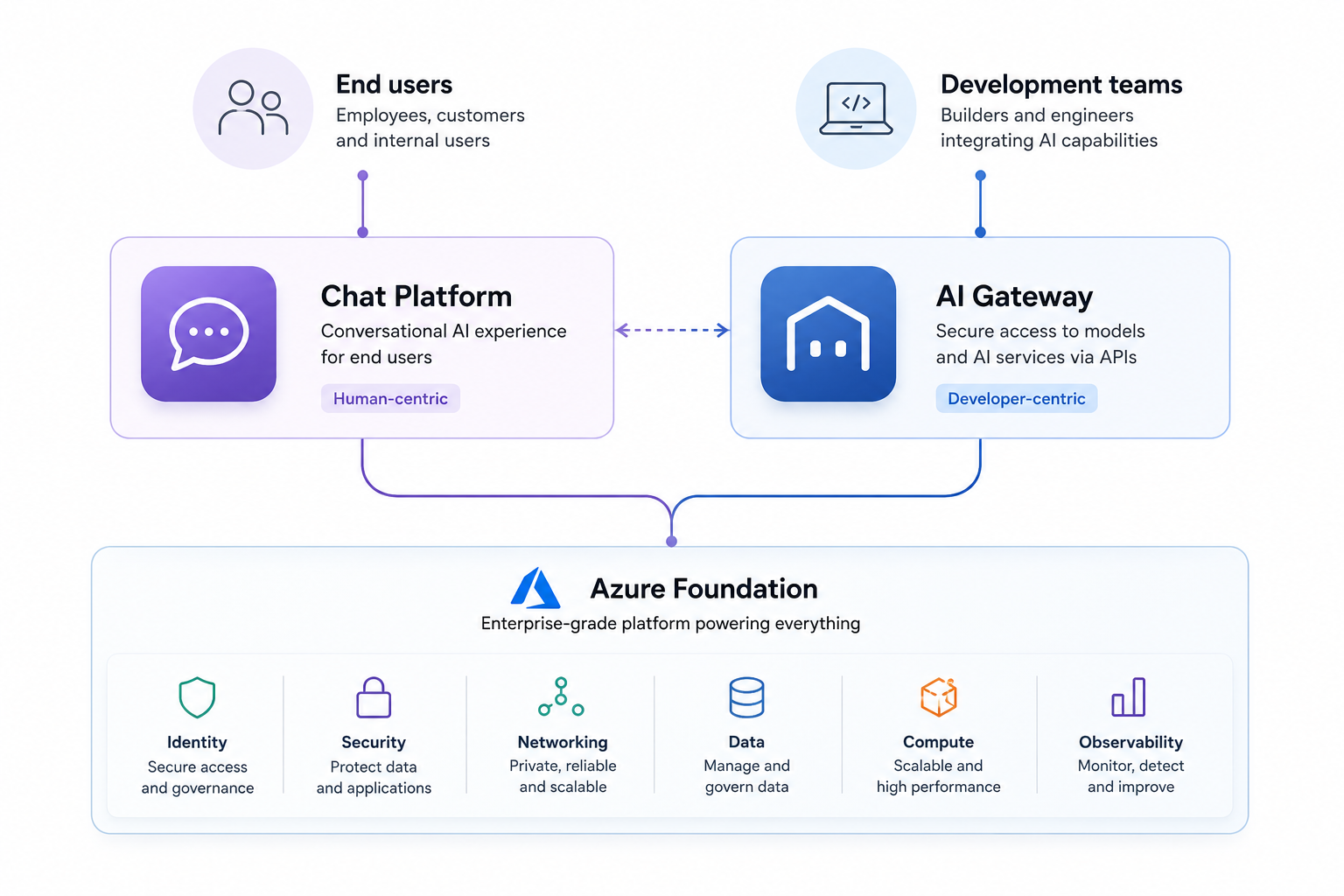
Behind the scenes, the AI gateway has become just as significant. By giving development teams a governed way to consume AI capabilities, it has unlocked use cases the university was not necessarily expecting on day one, from integrating AI into tools like VS Code through to building more sophisticated, tool-calling and agentic experiences. From an architectural perspective, the secure conversational platform is what people see, but the AI gateway is where the long-term innovation gets unlocked.
The platform was rolled out through a deliberate co-development approach, starting with an alpha cohort of 100 staff, expanding into a 400-person beta, and then opening up to the full 3,500-person workforce. Feedback from across faculties and professional services shaped the experience at every stage. The partnership has since moved into a second phase focused on governance and demonstrable value in teaching and research, building on the same foundations that proved themselves in phase one.
"Staff now have a safe environment where they can use AI, experiment with it, and build confidence in it. They know their data is being handled appropriately rather than being sent away without control. The AI gateway has become a real enabler, allowing our teams to solve practical problems and innovate in a governed way." — Richard added.
Looking ahead, Macquarie sees this work as the foundational layer of AI at the university rather than a finished destination. The roadmap includes lighting up frontier models as soon as it is practical to do so, expanding the gateway so more teams can build on top of it, and supporting people at every level of capability, from staff using conversational AI through to teams building coded solutions with pipelines, tool calling, and agentic capabilities. The ambition is to position the university's AI team as an enabler for the rest of the organisation, not a blocker to projects that want to put AI to work.